 Patrick Rice Co.
Google Search Console for AI visibility: what actually matters
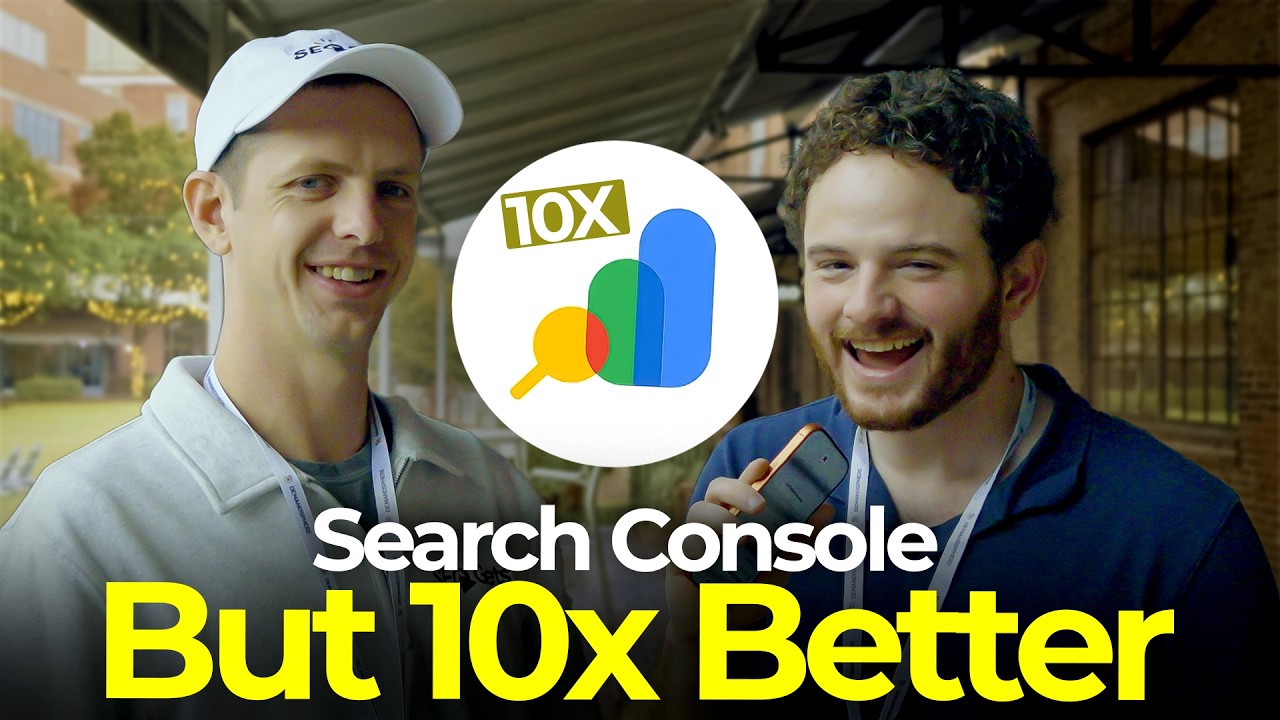
Google Search Console is still the most reliable place to start with AI visibility, because it is first-party data that shows what is actually moving the needle. Matt Mellinger of SEO Gets told me that Search Console and GA4 are still two of the top three tools for AI visibility in the latest report he has seen.
I talked with Matt at Tech SEO Connect about content groups, indexing, striking distance keywords, the SEO Gets MCP for Claude, and whether GEO is just SEO in a trench coat. Here is what he said and what I took from it.
What SEO Gets is and why I use it
Matt describes SEO Gets as the Search Console tool you wish Search Console was. It is a better, faster, easier to use version, with a free tier. It focuses on content grouping, prioritization, GA4 metrics and indexation, which he calls foundational SEO.
Matt says a lot of tools chase AI visibility and shiny object syndrome, while SEO Gets sticks to what SEOs need to do their job and report to stakeholders. Search Console has always been the main tool for real SEOs, but it is slow and clunky. SEO Gets makes the same data much easier to work with.
How do you use content groups, rising pages and declining pages?
Matt points out that Search Console shows raw data, and a lot of impressions come from pages that do not matter. He mentioned the great decoupling, where impressions grow while clicks decline. Even so, he says Search Console and GA4 are still the staples, because you can dig in and find where the impact is.
His approach is to group pages into content silos, which ties back to entities and grouping related things together. If a group is declining, you may have a bigger issue to understand, and that tells you where to focus. He also says to check your GA4 key events or revenue. A click does not make you money, but revenue and leads do.
Why prioritization matters when AI can create thousands of pages
Matt says everything about AI visibility comes down to prioritization. When you can ask Claude to create tens or hundreds of thousands of pages, he says that can often do more damage than good, and he pointed to the examples of sites that got hit over and over again.
More pages is not the plan. Knowing which group of pages deserves your attention is.
Why rank tracking is broken and first-party data wins
Matt says rank tracking is more broken than ever because of how Google presents results. I said they are poisoning the SERPs, and Matt added that it is purposeful. His conclusion is that first-party data is always going to be the most reliable, even with its exceptions.
One exception is anonymized queries, which SEO Gets accounts for and shows in its graphs. You still have to take everything in context, and that is what Matt tries to help you do.
The SEO Gets MCP: using Search Console data with Claude
An MCP connects your AI, like Claude, directly to your data. Matt explains that a plain API straight from Search Console hands the model all the data and leaves the LLM to dissect it. SEO Gets does a lot of pre-filtering so the input is cleaner, and the LLM only has to read and look for trends and patterns.
I had Claude Code build my own Search Console MCP in two seconds, but I seem to get better results with the SEO Gets MCP. It also has annotations, so I can ask Claude which of the things we changed in the last 12 months had the biggest effect. As an agency I can look across 100 profiles and see what moves the needle in my own data.
Matt says he did not release the MCP until he tried all kinds of edge cases and verified it through the API. SEO Gets does not do AI visibility or rank tracking, and Matt says it will not.
Finding SEO opportunities in 10 seconds
When someone asks me for my favorite SEO tool, I say SEO Gets, and I describe it as Search Console but better. A property that used to take me about 20 minutes to find an opportunity in now takes about 10 seconds.
In the interface I can see that a keyword dropped, so I re-optimize that page. Or I can see that a keyword just popped up, and we should probably make a page for it.
Search Console in the age of AI: indexing, direct/none and brand versus non-brand
Matt says foundations still matter. You still need to have your pages indexed, and if they are not, he says AI is not picking you up. He also sees more traffic moving to direct/none. In his own GA4 he noticed organic sessions drop, and when he zoomed out they had become attributed to direct/none. Nothing actually changed except the attribution.
SEO Gets tracks brand versus non-brand. The numbers are not exact because of anonymized queries, so you are looking for patterns and trends. Matt says to ask whether you are increasing, even if you only see 60 percent of the picture.
First-party sources for AI visibility: Bing and beyond
Matt says SEO Gets plans to add Bing in the next couple of weeks. His goal is to add more first-party sources so you get a more complete picture of how AI visibility is happening.
He says that is the most reliable way, rather than looking at AI visibility rankings that are hyper personalized. They are great for making stakeholders happy, he says, but for impact it is easier to go back to Search Console and GA4. There you can find content gaps, striking distance opportunities and cannibalization, which he says matters for AI visibility too.
Is GEO just SEO in a trench coat?
Matt thinks there is a lot of overlap, maybe 80 percent, but there are differences in how results surface. His most obvious example is that being mentioned in or getting backlinks from certain articles can perform better in GEO and AI visibility than in getting your SERP rankings higher.
He would rather argue less about the label and more about what is working. He describes this as a black box where testing matters, which is where annotations come in.
Where to find Matt and try SEO Gets for free
Matt is mostly on LinkedIn. SEO Gets has a free tier that gives you up to 50,000 rows, a faster experience, and the ability to connect all your Google accounts with unlimited users. He says they do not use your data.
I have a tutorial on SEO Gets and will release more, since it has a lot of capabilities.
Links from the video
What this means for your store
If you run a Shopify store, start with the data you own. Make sure your pages are indexed, watch your Search Console and GA4 trends, and use them to decide which groups of pages deserve your time before you worry about any AI visibility score.
Get your free AI visibility audit